The PFPS Interview: Former Idaho Supreme Court Justice Jim Jones and Luke Mayville from Reclaim Idaho on the Legal and Policy Fight Against Vouchers in that State
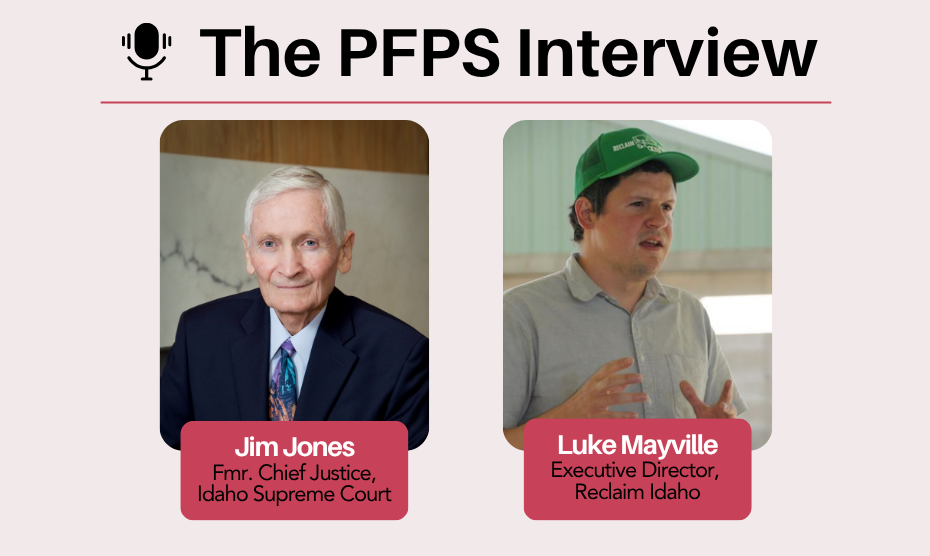
In this PFPS interview, Nicole Ciullo, Associate Director of Policy & Development at Education Law Center, which directs the Public Funds Public Schools campaign, spoke with Jim Jones, former Chief Justice of the Idaho Supreme Court, and Luke Mayville, Executive Director at Reclaim Idaho, about the voucher fight in their state. This interview has been edited for length and clarity.
Nicole Ciullo: Can you briefly introduce yourselves and share what led you to get involved in opposing Idaho's voucher program?
Jim Jones: I'm Jim Jones. I was the Attorney General of Idaho for eight years back in the 1980s, and I was on the state supreme court for 12 years. I've worked on a number of school issues, particularly school vouchers. After our voucher bill [HB 93] passed, another former Attorney General, Lawrence Wasden, and I got a lawsuit in the works to challenge the tax credit voucher law. We had to scratch around to get money, but we got it funded mostly by individuals here in the state. The thrust of our case was that the constitutional framers had set up a public school system in a single article of our constitution, and that there was simply no authority under the constitution to set up a separate school system or to fund private, particularly religious, education.
Luke Mayville: I grew up in public schools in north Idaho, and when we first launched Reclaim Idaho, I was in the northern part of the state. The whole idea of Reclaim Idaho was to reclaim the tradition in our state of bipartisan commitment to public education. There’s been a pretty steady erosion over the last 30 years of investment in public schools. Idaho Center for Fiscal Policy has done excellent work on this, charting out how even as we've slightly increased public education funding over time, if you look at it as a percentage of our economy, our investment is actually shrinking. That means it's not enough to keep up with inflation and population growth; it's not enough to compete with other states when it comes to teacher salaries; it's not enough to cover basic maintenance of school buildings, where we have an estimated $8 billion funding gap in our school building infrastructure. We as an organization have viewed public education as the cornerstone of our democracy and as a central institution of communities all across the state, especially rural communities.
Ever since we became aware of the private school voucher issue, starting at least six or so years ago, it was very clear to us that vouchers are a direct threat to the integrity of public education, both because of the ways they undermine education itself and because they're yet another drain on revenue. In so many ways, the story of the last 30 years in our state has been a story of lawmakers prioritizing large-scale tax breaks for corporations and the wealthy over the commitment to public education. Private school vouchers are just an extension of that because they're yet one more giveaway to a targeted group that doesn't need a tax break. Reclaim Idaho first got involved in the fight against vouchers back in 2022, along with other pro-public education organizations, leaders, and lawmakers in the state. We're very proud to have been a part of several cycles where we actually successfully blocked voucher legislation, but in the last election season, there was an unprecedented onslaught of out-of-state funding that really smeared any pro-public education candidates, leading to a major turnover in the legislature that made it very difficult to block voucher legislation in the 2025 session.
NC: What do you see as the biggest harms of vouchers for Idaho students, schools, and communities?
JJ: There are groups that want to have religion controlling what the kids are taught in schools and what the teachers are able to say. I think vouchers are going to lead to continued deterioration. I mean, we're the 51st state in supporting schools. We used to at least claim we were above Mississippi, but that isn’t the case anymore. The legislature has also done such destructive things as claiming that the kids are being indoctrinated with CRT and DEI and this, that, and the other thing. You can't even put a poster in the classroom that says “everybody is welcome here” because that's some kind of communist plot. So, unless something turns around, I think it's going to be a continual downhill slide and deterioration of public education.
LM: For many years now, we’ve been dead last, 51 out of 50 states plus the District of Columbia, in funding per student. It shows up in the form of an $8 billion gap in our school facilities infrastructure. It shows up in a $100 million gap in special education funding. By the way, both of those numbers are actually numbers arrived at by state agencies that have done studies of the needs for both special education and school facilities. Those types of funding shortfalls have devastating impacts on communities across the state. We've had investigative reports in Bonners Ferry finding that the school facilities were in such disrepair that elementary school students had to wear heavy winter gear into their classrooms during the winter because the heat didn't work, and then in the early fall or late spring when it started to warm up, it was too hot in the classrooms to be able to concentrate. And then in Salmon, there was sewage leaking into the cafeteria kitchen because the building was in such disrepair, and for cycle after cycle, the voters were unable to pass a local vote to get the building repaired. Idaho also has several bordering states where if you're a teacher, you can just cross the border and get paid $20,000 more a year, and that is a constant threat to the quality of our public education system because it makes it so difficult to recruit and retain teachers. In the bigger picture, when we talk about the damage of private school vouchers specifically, we're moving towards treating education as a private commodity or a marketplace as opposed to a public good. And we have a tradition in our country and in our state and in our constitution of treating education as a public good both in the sense that every single child deserves it and in the sense that it's a good that benefits everyone even if you yourself are not a student, and even if you yourself do not have a child in the education system.
NC: Jim, even before the voucher program passed, you had an eye toward litigation. Can you talk about the advocacy and legal work that occurred before the program passed, and what advocates can do during that pre-passage stage?
JJ: Right before the last legislative session, I put together a really comprehensive piece on the proposed voucher program. I talked about the "no-aid clause” in the Idaho Constitution that prohibits funding of religious schools, and how if they did try to make a voucher program, it would be a clear violation of that provision of the constitution, and while the U.S. Supreme Court gave them a back door around the provision, it would still be a violation of the state constitution. The route we chose was to go directly to the Idaho Supreme Court and say this is clearly unconstitutional. If we had talked about the impact on our public school system generally, we knew they would kick it back to district court, and it'd take years to get it litigated. We thought we had a really good case, and we did have a couple of justices who came from that area of the state that is underserved by private schools, and our court has been pretty good. But, you know, we didn't get what we wanted.
LM: We knew during the 2025 legislative session that it was a real uphill battle because of the changes that had been made in the legislature. But at every step of the way, we mobilized people from all over the state to testify at every possible hearing, and a lot of people came out of the woodwork to testify whether or not they were associated with our organization or any organization. There was an organic movement against the voucher program. It was very clear that the number of people actively opposed to vouchers was much larger than whatever energy there was on the ground in favor of them.
We thought it was really important to debunk the narrative that there's some type of grassroots movement for vouchers, this idea that somehow during the pandemic parents all across the country, including in Idaho, got really fed up with public schools and now they want an alternative. What we were able to demonstrate pretty clearly is that in terms of the on-the-ground energy, there's a lot more people who firmly believe in public education than there are people who are trying to dismantle it. For example, in the first major public hearing, the people who signed up to testify against the voucher bill outnumbered the people testifying for it by something like 10 to 1. And then, in a really dramatic moment, 37,000 people called the governor's office, more calls than for any other bill in Idaho history. Of those who called, 86% of them wanted him to veto it.
It wasn't enough to defeat the bill, but it did really challenge the voucher push in a significant way. At one point, in the House Revenue and Taxation Committee, the bill only got through by one vote, and then once it made it to the Senate floor, it only got through by a few votes. It’s very possible that if President Trump hadn't tweeted in support of the bill in the lead-up to the Senate vote, we might have had a one-vote victory blocking its passage. There were one or two senators who flipped their vote after President Trump tweeted about it. So all that is to say that in spite of losing that fight, all of the organizing and mobilizing really made it a close one, and that organizing built on many years of organizing around that issue and going out and identifying all of the counties in the state that don't have private schools in them, going to those counties and door knocking, and getting people to sign on to a “say no to vouchers” petition. We started that work early and that helped us build up a list of people, including in very conservative rural communities around the state, who were very skeptical or outright opposed to this type of program.
NC: Jim, can you walk me through the lawsuit, your legal claims, and what the court decided?
JJ: Our thrust was that the constitution simply did not allow an alternate school system; there's nothing in the Idaho Constitution that would indicate that the framers intended to use public money for private education. There’s a compulsory education requirement in our constitution where you have to attend public schools unless the legislature allows some other means. At the time the constitution was drafted, the only other means were home schools, private schools and some religious schools. So, if you provide funding for one, those others are excluded, and the court didn't seem to be compelled with that.
We didn't pursue claims based on the no-aid clause in the constitution or public school funding levels. But that can potentially be done going forward. I think we probably could put together a really good case to say that the private money being diverted from the state coffers does adversely impact the public school system, and the more that they increase it, which is the normal trajectory of voucher programs, the more that impact will occur. But again, that's a long slog, and probably beyond the resources that we could muster. You know, the pro-voucher out-of-staters can bring in all of those resources from the Koch-type groups to run the elections and lobby for this kind of legislation. We simply don't have access to that kind of money. It's just a real problem.
NC: The door is still open to litigation in the future once you know the actual impact of the program, is that right?
JJ: Right.
LM: And I'll just add, there's a concurring opinion in the case where Justice Moeller said that very clearly, saying that at this point some of the predicted harm to public schools is hypothetical, or, something to that effect, but it may not be in the future, so the door is still open. Another important thing I'd add is that a few days ago, there was a constitutional amendment proposed in the Idaho Legislature to repeal the no-aid clause, and that constitutional amendment was blocked by a bipartisan coalition of pro-public education legislators. That was at least a small victory in an otherwise pretty dark era.
NC: So how will you fight the voucher program moving forward?
LM: For us at Reclaim Idaho, we have a campaign called “Not a Dollar More,” where we helped organize about 30 town halls over the past nine months since the program originally was enacted. We also circulated a petition all around the state calling on lawmakers to vote no on any bill that removes the $50 million cap on the program. One strategic advantage we have right now is the cap, and that exists in part because it was such a difficult fight for them to get this passed. Had they not capped the program at a relatively low amount, they probably wouldn’t have had votes to get it through. There’s a number of legislators who have indicated that even though they voted yes for the program, they're nervous about expanding it. They've heard a lot from their constituents since the passage of the program and they don't like it, and there's a very dire budget situation right now in Idaho. We believe that with some good organizing, we can stop the expansion at the very least for this legislative session and maybe another legislative session. And if we can successfully do that, we can stop the momentum of the program, and importantly, we can buy ourselves some time to work on other strategies of rolling it back, piece by piece, and in the long run, pursuing a strategy to repeal it altogether.
The strategy of repeal is likely to require some shifting in the legislature. There are also potential opportunities through the ballot initiative process that we'll be exploring. We're very encouraged by some of the experimentation in other states, like in Arizona. But for now, we're organizing around the slogan “not a dollar more,” and demanding that legislators vote no on any bill that would lift that $50 million cap.
NC: Jim, is there anything you'd like to add?
JJ: Well, my druthers would be to yank the thing out, root and branch. I have drafted an initiative that would do that, but I guess we'll have to see what happens in the legislature. I don't think they will have the nerve to really try to get more money into the program this year because they've been cutting out practically everything that makes the state go. I think that we did, if nothing else, with our lawsuit, focus attention on the program and got a lot of people off the fence.
NC: What advice would you have for others who are considering litigation or other advocacy efforts to challenge voucher programs? What have you learned from your experience that they should keep in mind?
JJ: Well, if they do have a program underway, they can contact me. I would be glad to give any advice and answer the questions that they raise just based on what we found here. We had some states that we relied on—Florida, South Carolina, and Utah—where similar cases have been brought. Our court doesn't look much to out-of-state decisions, but the strategies that they used and the legal precedents that they rely on are helpful. But we have a number of people that learned a lot during this process here, and we're always happy to help out if people have specific questions to direct to us.
NC: Thank you. Luke?
LM: I'll just add that it would be wise for anyone considering a legal strategy to view that strategy as one part of a multifaceted strategy, and to not focus so single-mindedly on the courts that you overlook the power of the citizenry. However, even when the courts decide to rule, the fight probably isn't going away. In Idaho, had we won in court, I think it's somewhat likely that the pro-voucher forces would have regrouped and tried to figure out a way to pass another bill that somehow dodges the court's ruling. This is going to be a longer-term fight, and we've got to be in it for the long haul because there are so many forces amassed that are trying to dismantle public education in our country. Something that gives me a lot of hope is that when it comes to the citizenry, public education is something that has a built-in constituency. That's especially true in small-town communities where the public schools are often the number one employer. They're the only option for many people when it comes to education. With good organizing, those people can be activated and can be built into advocates for public education. I would recommend that even as we pursue legal strategies, we also pursue citizen strategies that keep a strong focus on organizing.
NC: That is great advice. Is there anything else you'd like to share before we conclude this interview?
JJ: Just that it's nice to know that we've got simpatico partners across the country. It’s encouraging, and it's comforting to know that we have so many good people who are moving along the same path